

- Accounting, AI, Professional Services, Sage Intacct
For many professional services firms, managing projects, resources, invoicing, and profitability is relatively straightforward in the early stages of growth. However, as the business expands, takes on more clients, and delivers a wider range of services, these processes often become more complex. A project that initially appears profitable can quickly become less successful when factors such as resource allocation, time tracking, and delayed billing are considered.
This is often the point where businesses begin to recognise the limitations of their existing finance software. While financial records may remain accurate, gaining a complete view of operational and project performance can become increasingly difficult.
Whether your organisation delivers project-based services or ongoing client engagements, accounting software for professional services should offer more than core financial management. It should bring together finance, project management, time and expense tracking, billing, and profitability reporting, helping businesses gain greater visibility and make informed decisions as they scale.
Why professional services need more than basic accounting software
Professional services organisations operate differently from businesses that primarily sell products. Their success is heavily influenced by the effective use of people, skills, expertise, and billable time.
A standard accounting package may record transactions and track invoices, but it often lacks the functionality needed to understand project performance in detail. For example, can your current system identify projects that are exceeding budget? Can it highlight resource bottlenecks, monitor profit margins, or compare forecast revenue against actual results? Can it provide early warning signs of potential cash flow challenges?
When critical information is spread across spreadsheets, project management tools, and separate finance systems, obtaining meaningful insights becomes more difficult. Employees spend valuable time gathering data rather than analysing it. By contrast, the right accounting software for professional services firms provides a connected view of business operations, reducing manual reporting and giving decision-makers immediate access to the information they need.
How Sage Intacct Professional Services provides financial control
Sage Intacct is a cloud-based financial management solution designed to help growing organisations improve visibility, control, and reporting.
Built for project-driven businesses such as consultancies, engineering firms, IT providers, marketing agencies, and recruitment companies, Sage Intacct Professional Services combines advanced financial management capabilities with integrated professional services automation PSA software functionality.
The solution delivers real-time dashboards, comprehensive reporting, and automation tools that simplify day-to-day processes. This allows businesses to monitor performance across projects, departments, entities, and locations without waiting for month-end reports.
For leadership teams, this creates a clearer view of business performance. Finance teams benefit from reduced manual processing and fewer spreadsheet-based tasks, while project managers gain better insight into budgets, costs, and project delivery. The result is stronger operational control, improved client service, and greater confidence when planning for future growth.
Project insights with Sage Intacct for Professional Services
Professional services organisations require more than traditional accounting functionality. They need professional services automation software solutions that help connect projects, people, resources, and financial performance.
Sage Intacct Professional Services supports organisations with capabilities including:
- • Custom software for professional services
- • Real-time dashboards and KPI monitoring
- • Project accounting and profitability analysis
- • Automated revenue recognition
- • Multi-entity financial consolidation
- • Integration with CRM, resource planning, and operational systems
- • Improved visibility of resource utilisation, forecasting, and profit margins
These capabilities help businesses move away from disconnected systems and manual reporting processes, providing a more accurate and timely view of performance.
For example, finance teams can monitor billing and time tracking more effectively, while leadership teams can assess profitability by project, client, service line, or department. Having access to reliable, real-time information supports better decision-making and reduces reliance on assumptions.
Common signs your current system is holding you back
Many organisations do not immediately recognise when they have outgrown their finance software. The warning signs often emerge gradually through additional manual work, delays, and process inefficiencies.
You may find that time recording relies on spreadsheets, invoicing cycles are becoming longer, or project managers lack visibility into project costs and profitability. Resource planning may also be disconnected from project data, resulting in employees being over-utilised or under-utilised.
While these challenges may seem manageable initially, they often become more significant as the organisation grows. Processes become dependent on individual knowledge, information becomes harder to access, and leadership teams may be relying on reports that are already outdated by the time they are reviewed.
The best professional services automation software helps centralise these activities, making information accessible across finance, project management, and resource planning teams. When data is connected across the organisation, teams can work more efficiently, improve client outcomes, and gain the insights needed to support long-term growth.
Speak to Envisage about accounting software for professional services
If your current system is making it difficult to manage projects, resources, billing, profitability, or reporting, it may be time to consider a more connected solution.
The right professional service automation software can unite finance and operational processes, giving your organisation greater visibility, improved efficiency, and a stronger platform for growth.
At Envisage, we have helped organisations implement Sage Intacct across a wide range of industries, including professional services. Our team provides expert advice, implementation support, and ongoing guidance to help businesses maximise the value of their investment.
If you would like to see how Sage Intacct Professional Services can support your organisation, book a demo with our team today. We can help you assess where professional services automation software could improve efficiency, strengthen reporting, and support your future growth plans.
Want to see how modern finance teams are using Sage Intacct to work smarter and scale more effectively?
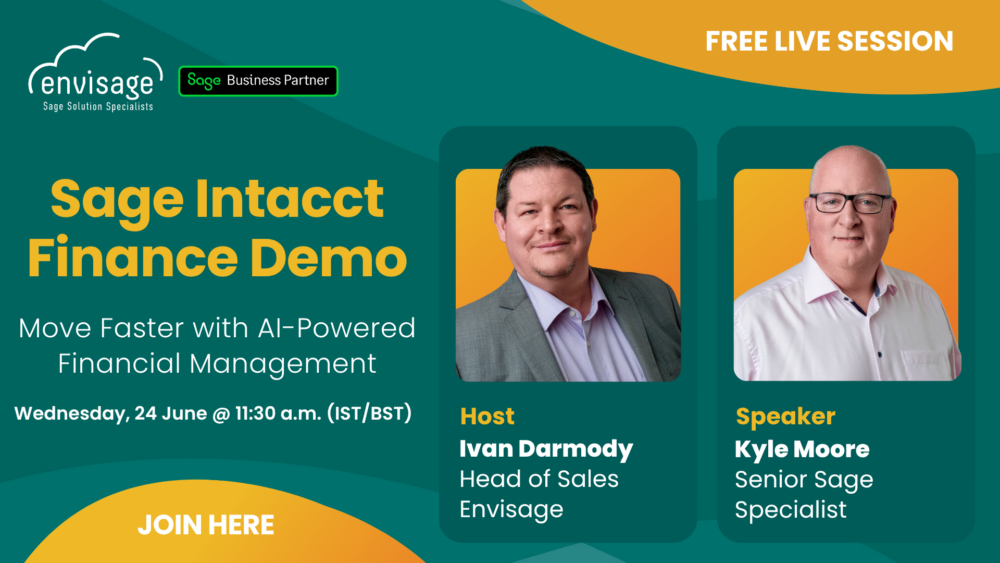
Join Ivan and Kyle on 24 June for our webinar, Move Faster with AI-Powered Financial Management. Discover how organisations across the UK and Ireland are using AI-powered financial management to reduce manual processes, gain real-time visibility, strengthen governance, and enable finance teams to support growth with confidence.
Register for the webinar today.
About the Author

David Burke
David Burke, the Technical Director for Envisage, is responsible for developing bespoke and off-the-shelf solutions, including easyDD for Sage. In 2023, he achieved accreditation as a Sage Intacct Implementation Certified Consultant.