
Business professional using a tablet and laptop in an office, reviewing Sage Intacct Professional Services automation software and project data.

The Best Accounting Software for Professional Services

Business professional using a tablet and laptop in an office, reviewing Sage Intacct Professional Services automation software and project data.

For many professional services firms, managing projects, resources, invoicing, and profitability is relatively straightforward in the early stages of growth. However, as the business expands, takes on more clients, and delivers a wider range of services, these processes often become more complex. A project that initially appears profitable can quickly become less successful when factors such as resource allocation, time tracking, and delayed billing are considered.

This is often the point where businesses begin to recognise the limitations of their existing finance software. While financial records may remain accurate, gaining a complete view of operational and project performance can become increasingly difficult.

Whether your organisation delivers project-based services or ongoing client engagements, accounting software for professional services should offer more than core financial management. It should bring together finance, project management, time and expense tracking, billing, and profitability reporting, helping businesses gain greater visibility and make informed decisions as they scale.

Why professional services need more than basic accounting software

Professional services organisations operate differently from businesses that primarily sell products. Their success is heavily influenced by the effective use of people, skills, expertise, and billable time.

A standard accounting package may record transactions and track invoices, but it often lacks the functionality needed to understand project performance in detail. For example, can your current system identify projects that are exceeding budget? Can it highlight resource bottlenecks, monitor profit margins, or compare forecast revenue against actual results? Can it provide early warning signs of potential cash flow challenges?

When critical information is spread across spreadsheets, project management tools, and separate finance systems, obtaining meaningful insights becomes more difficult. Employees spend valuable time gathering data rather than analysing it. By contrast, the right accounting software for professional services firms provides a connected view of business operations, reducing manual reporting and giving decision-makers immediate access to the information they need.

How Sage Intacct Professional Services provides financial control

Sage Intacct is a cloud-based financial management solution designed to help growing organisations improve visibility, control, and reporting.

Built for project-driven businesses such as consultancies, engineering firms, IT providers, marketing agencies, and recruitment companies, Sage Intacct Professional Services combines advanced financial management capabilities with integrated professional services automation PSA software functionality.

The solution delivers real-time dashboards, comprehensive reporting, and automation tools that simplify day-to-day processes. This allows businesses to monitor performance across projects, departments, entities, and locations without waiting for month-end reports.

For leadership teams, this creates a clearer view of business performance. Finance teams benefit from reduced manual processing and fewer spreadsheet-based tasks, while project managers gain better insight into budgets, costs, and project delivery. The result is stronger operational control, improved client service, and greater confidence when planning for future growth.

Project insights with Sage Intacct for Professional Services

Professional services organisations require more than traditional accounting functionality. They need professional services automation software solutions that help connect projects, people, resources, and financial performance.

Sage Intacct Professional Services supports organisations with capabilities including:

  • Custom software for professional services
  • Real-time dashboards and KPI monitoring
  • Project accounting and profitability analysis
  • Automated revenue recognition
  • Multi-entity financial consolidation
  • Integration with CRM, resource planning, and operational systems
  • Improved visibility of resource utilisation, forecasting, and profit margins

These capabilities help businesses move away from disconnected systems and manual reporting processes, providing a more accurate and timely view of performance.

For example, finance teams can monitor billing and time tracking more effectively, while leadership teams can assess profitability by project, client, service line, or department. Having access to reliable, real-time information supports better decision-making and reduces reliance on assumptions.

Common signs your current system is holding you back

Many organisations do not immediately recognise when they have outgrown their finance software. The warning signs often emerge gradually through additional manual work, delays, and process inefficiencies.

You may find that time recording relies on spreadsheets, invoicing cycles are becoming longer, or project managers lack visibility into project costs and profitability. Resource planning may also be disconnected from project data, resulting in employees being over-utilised or under-utilised.

While these challenges may seem manageable initially, they often become more significant as the organisation grows. Processes become dependent on individual knowledge, information becomes harder to access, and leadership teams may be relying on reports that are already outdated by the time they are reviewed.

The best professional services automation software helps centralise these activities, making information accessible across finance, project management, and resource planning teams. When data is connected across the organisation, teams can work more efficiently, improve client outcomes, and gain the insights needed to support long-term growth.

Speak to Envisage about accounting software for professional services

If your current system is making it difficult to manage projects, resources, billing, profitability, or reporting, it may be time to consider a more connected solution.

The right professional service automation software can unite finance and operational processes, giving your organisation greater visibility, improved efficiency, and a stronger platform for growth.

At Envisage, we have helped organisations implement Sage Intacct across a wide range of industries, including professional services. Our team provides expert advice, implementation support, and ongoing guidance to help businesses maximise the value of their investment.

If you would like to see how Sage Intacct Professional Services can support your organisation, book a demo with our team today. We can help you assess where professional services automation software could improve efficiency, strengthen reporting, and support your future growth plans.

Want to see how modern finance teams are using Sage Intacct to work smarter and scale more effectively?

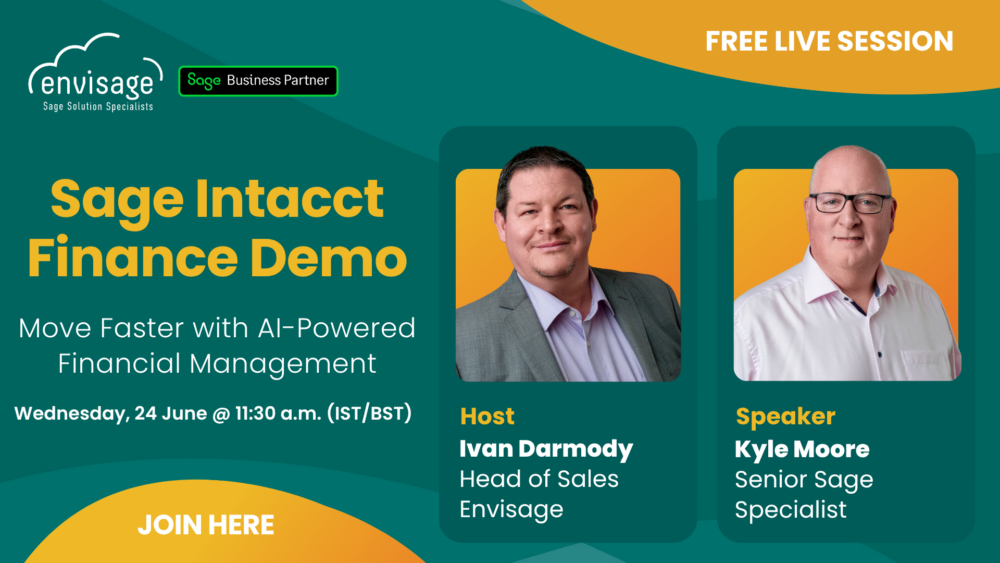
Join Ivan and Kyle on 24 June for our webinar, Move Faster with AI-Powered Financial Management. Discover how organisations across the UK and Ireland are using AI-powered financial management to reduce manual processes, gain real-time visibility, strengthen governance, and enable finance teams to support growth with confidence.

Register for the webinar today.

About the Author

Picture of David Burke

David Burke

David Burke, the Technical Director for Envisage, is responsible for developing bespoke and off-the-shelf solutions, including easyDD for Sage. In 2023, he achieved accreditation as a Sage Intacct Implementation Certified Consultant.

Businesswoman working on laptop in retail shop using best AI accounting software like Sage Intacct

Best AI Accounting Software: Making Finance Feel Less Like a Chore

Businesswoman working on laptop in retail shop using best AI accounting software like Sage Intacct

With AI continuing to dominate conversations, we’re revisiting insights from our CEO, Ray Ryan, originally shared in InBusiness’ Winter issue last year. His view on how AI is influencing ERP and financial management remains highly relevant today – if anything, its impact is becoming more evident in how finance teams now operate.

AI is already shaping areas such as reporting, month-end close, forecasting, and everyday data management. While these changes may seem subtle, they are steadily transforming how finance functions run.

And this shift is important. Finance teams have long been under pressure. Tight month-end deadlines, reconciliations, reporting cycles, and ongoing spreadsheet work demand significant time and effort. The issue has never been a lack of capability, but rather limited capacity.

AI in finance: Less admin, more clarity

For years, finance teams have depended on manual processes that, while necessary, are time-intensive. These tasks keep operations moving but often come at the expense of deeper analysis and strategic thinking.

This is where AI is making a meaningful difference. Rather than replacing finance professionals, it supports them by handling repetitive tasks and improving how information flows across the business.

  • Reduced time spent on manual data entry and reconciliations
  • Quicker access to real-time financial insights
  • Fewer errors caused by repetitive processing
  • More time available for forecasting, analysis, and decision-making
  • Improved visibility across the organisation instead of siloed reporting

The real advantage is not just efficiency, but clarity. When teams are freed from administrative tasks, they can focus on interpreting data rather than chasing it. This is a key reason why solutions like Sage Intacct are gaining increased attention.

Does Sage Intacct use AI? A practical look at how it works

Sage Intacct incorporates AI in a practical and accessible way. Instead of positioning AI as a separate feature, it is embedded directly into everyday financial workflows.

Tools such as Sage Copilot and built-in AI agents provide real-time support, operating within existing processes rather than alongside them. This ensures that AI enhances daily activities without introducing unnecessary complexity.

At its core, the approach focuses on embedding intelligence into routine tasks – from automation and anomaly detection to enhanced reporting. The aim is not to disrupt how finance teams work, but to gradually improve efficiency and accuracy.

As Ray highlights, “Prospects are increasingly looking for AI capabilities, and partners who understand the right tools and how to apply them.” This distinction matters. The value of Sage Intacct lies not only in its AI features, but in how effectively they are applied in real-world finance environments.

Smarter accounts payable without the stress

Accounts payable is one of the areas where AI delivers immediate, tangible benefits.

Tasks such as invoice capture, matching, and approvals are repetitive but time-consuming. As a result, many finance teams are seeking more efficient ways to manage AP processes.

With AI embedded into these workflows, Sage Intacct reduces manual input while improving accuracy. Instead of relying on time-intensive checks, key steps can be automated, allowing approvals to move faster and more smoothly.

The result is straightforward: reduced manual effort, quicker processing times, and improved visibility into supplier data.

Month-end without the usual pressure

The month-end close is often one of the most demanding periods for finance teams. Tight timelines and last-minute adjustments can create significant pressure.

AI helps bring more structure to this process. Rather than concentrating activity at the end of the period, teams can maintain better oversight throughout the month.

This shift leads to fewer surprises, reduced last-minute issues, and greater confidence in the final figures.

AI that helps day to day

While large processes like AP and month-end are key, much of AI’s value is realised in everyday tasks.

Sage Intacct AI tools support day-to-day finance by enabling:

  • Real-time reporting across the business
  • Faster access to insights when needed
  • Ongoing monitoring of transactions for anomalies
  • Reduced reliance on manual data gathering

These features help remove friction from daily operations, particularly when it comes to reporting and overall visibility.

Supporting growth without adding complexity

As organisations expand, financial management naturally becomes more complex. Additional systems, entities, and data sources can slow processes if not properly connected.

Sage Intacct’s AI enhancements help keep things manageable. By improving how data flows between systems, finance teams can maintain oversight without increasing manual workload.

This allows finance functions to scale alongside the business, without adding unnecessary pressure.

Beyond growth, this shift highlights a broader point about AI in finance.

At its core, AI is not about replacing people or completely redefining roles. It is about creating space – space to focus on analysis rather than administration, to plan ahead instead of reacting, and to make more informed decisions.

As Ray Ryan notes, “AI can only go so far… it will be very difficult to replace or supersede the human element.” This balance is what makes AI effective. It supports the work, but people remain central to decision-making.

Final Thoughts

Selecting the best AI accounting software ultimately comes down to how much it simplifies day-to-day finance operations.

More importantly, the real transformation lies in how finance teams use their time.

When AI improves access to data, teams can move beyond simply compiling figures and instead focus on what those figures mean for the business. This shift, from reporting to interpretation is where stronger decision-making, better planning, and more confident financial leadership begin.

As AI continues to evolve, the question is no longer whether finance teams should adopt it, but how to implement it in a way that adds value without increasing complexity.

Get in touch with our team to book a free Sage Intacct demo today.

About the Author

Picture of David Burke

David Burke

David Burke, the Technical Director for Envisage, is responsible for developing bespoke and off-the-shelf solutions, including easyDD for Sage. In 2023, he achieved accreditation as a Sage Intacct Implementation Certified Consultant.

Diverse non-profit team collaborating in office using charity accounting software and Sage Cloud dashboards

How Non-Profits Can Turn Financial Data into Strategic Decisions with Sage Dashboards

Diverse non-profit team collaborating in office using charity accounting software and Sage Cloud dashboards

Non-profits are facing increasing pressure to demonstrate impact while adapting quickly to change. Boards are asking for clearer insights, funders expect more detailed reporting, and internal teams need better visibility into programme performance. Despite this, many organisations still depend on spreadsheets, manual processes, and static reports that are often outdated by the time they are reviewed.

With Sage Intacct’s non-profit accounting software, reporting and dashboards are built to help organisations shift from reactive analysis to forward-looking decision-making. Finance and leadership teams gain access to real-time insights, providing a clearer picture of performance across the organisation.

From our experience working with non-profits across the UK, a common challenge continues to emerge: organisations have access to large volumes of data, but it is difficult to retrieve, time-consuming to analyse, and challenging to present in a way that supports confident decisions.

Moving to modern charity accounting software can significantly improve this.

The issue with ‘last month’ reporting

If your finance system only provides a view of last month’s performance, it limits your ability to influence what is happening now. Many organisations go through lengthy processes of closing books, exporting reports, and analysing data for stakeholders, only to find that circumstances have already shifted.

We regularly hear from non-profit finance teams who feel caught in this cycle. A significant amount of time is spent collecting and verifying data, leaving less time for meaningful analysis. As a result, decisions are often guided by instinct rather than accurate, up-to-date information, making planning more uncertain over time.

One of the key benefits of adopting a cloud-based solution like Sage Intacct is access to real-time financial insights. Rather than relying on historical reports, teams can monitor performance as it happens and respond accordingly.

Real-time financial visibility for non-profits

Effective reporting and dashboards should simplify how organisations answer critical questions from leadership, trustees, and funders, including:

  • Are we meeting this year’s budget and long-term financial commitments?
  • Which programmes or locations are under financial strain?
  • How are restricted funds being utilised, and can we clearly demonstrate accountability?
  • What impact will scaling a project have on cash flow and reserves?

When answering these questions requires manual reporting or combining multiple spreadsheets, decision-making slows down. In a fast-paced funding environment, delays can have serious consequences.

With Sage Intacct, organisations benefit from connected, real-time data that supports quicker, more informed decisions. Designed for those managing multiple funds, grants, and projects, this Sage software reduces complexity and supports more strategic thinking.

The role of Sage Intacct for non-profits

Sage Intacct is a modern, cloud-based solution widely adopted by non-profits as they move beyond entry-level systems. Built specifically with charities in mind, it supports fund and grant accounting while offering advanced reporting capabilities within an intuitive interface.

Match financial data to how your organisation works

Sage Intacct allows financial data to be viewed by programme, fund, grant, location, or project. Instead of relying on complex spreadsheets, teams can access insights in a format that aligns with how their organisation operates.

Give boards and leaders clearer insight

Providing timely and relevant insights to boards and leadership teams becomes far easier. With access to up-to-date data, discussions can move beyond reviewing figures to focusing on strategy, risk, and future priorities.

Build trust with donors and funders

Transparency plays a key role in building and maintaining trust. Improved reporting enables organisations to clearly demonstrate where funding originates, how it is allocated, and the outcomes it delivers. Over time, this level of visibility strengthens relationships with donors and stakeholders.

Ultimately, charity accounting software goes beyond improving reporting. It helps teams identify issues earlier, supports more informed discussions, and enables organisations to demonstrate impact more effectively—freeing up time to focus on strategic goals.

Using dashboards to drive better decisions

Sage Intacct offers a range of dashboards tailored specifically for non-profits, transforming complex data into clear, actionable insights for different roles within the organisation.

  • Role-based dashboards provide finance leaders, executives, and managers with relevant insights without unnecessary complexity
  • Fundraising dashboards track donor activity, campaign performance, and key metrics in one place
  • Outcome dashboards combine financial and operational data to highlight real-world impact
  • Integration dashboards bring together data from multiple systems, reducing manual work and improving overall visibility

These dashboards help teams stay focused on what matters most – whether that’s managing budgets, improving fundraising efforts, or demonstrating impact.

Moving from spreadsheets to structured reporting

Most non-profits rely on at least one critical spreadsheet, often managed by only a few individuals. While these can be effective in the short term, they introduce risk and limit scalability.

By centralising data within a cloud platform like Sage Intacct, organisations can reduce their dependence on spreadsheets and make information more accessible. While reports can still be exported when needed, the system becomes a single, reliable source of truth.

With built-in AI capabilities such as Sage Ai and Sage Copilot, Sage Intacct can automate routine processes, reduce manual data entry, and deliver real-time insights – allowing finance teams to work more efficiently and focus on strategic decision-making.

Want to see what better reporting looks like?

Access to accurate, real-time insights is essential for safeguarding funding, demonstrating impact, and making confident decisions about the future. With the right tools in place, finance teams can spend less time preparing data and more time using it to guide the organisation forward.

To see how this works in practice, download our Non-Profit Dashboards & Reporting Brochure. It explores how purpose-built dashboards can simplify compliance, improve visibility, and strengthen financial oversight, with practical examples to help you move beyond manual reporting.

If you are exploring charity accounting software or looking to get more value from your current system, this is a great place to start. Our team at Envisage is always available to discuss your requirements and guide you through the next steps, feel free to get in touch today.

About the Author

Picture of Chris Hawley

Chris Hawley

Chris is the Managing Director at The Noledge Group and brings over 34 years of experience delivering ERP solutions across industries like retail, distribution, manufacturing, and construction. During his 24 years at Sage, he worked with nearly every product and notably transformed Sage 200 as its Product Manager, turning it into a leading solution for SMEs in the UK and Ireland. Chris takes pride in the continued success of Sage 200, supported by Sage Business Partners like Envisage.

Big data technology concept with financial data visualisation representing Sage Intacct implementation and cloud insights

What Makes Sage Intacct Different from Traditional Accounting Software?

Big data technology concept with financial data visualisation representing Sage Intacct implementation and cloud insights

The best accounting software doesn’t just record numbers – it supports how your business operates today and where it’s heading next. 

Many businesses start with a simple system supported by spreadsheets. It works… until it doesn’t. As operations grow, that patchwork approach can quickly become a bottleneck, limiting visibility and slowing decision-making. 

The real difference between entry-level tools and a modern financial platform isn’t just features. It’s whether you have access to real-time, reliable data that helps you make confident, strategic decisions – not just keep up with transactions.

Why the right choice matters

Most finance teams begin with basic accounting tools, often supported by spreadsheets. This setup can work well in the early days, when transaction volumes are low and reporting needs are simple. 

But as your business grows – adding entities, locations, or revenue streams – cracks begin to show. 

We often speak to finance leaders who spend too much time on manual reconciliations, offline reports, and workarounds just to get a clear picture at month-end. While this may “get the job done,” it leaves little time for forecasting, analysis, and planning – the activities that actually drive growth. 

What is traditional accounting software?

Traditional accounting software typically refers to on-premise systems, desktop applications, or entry-level cloud tools designed for basic bookkeeping. 

They usually focus on core functions like: 

  • Accounts payable and receivable  
  • Bank reconciliation  
  • VAT processing  

While these systems can keep your books in order, they often rely heavily on manual processes and spreadsheets for reporting.

They also tend to struggle with: 

  • Multi-entity or multi-currency requirements  
  • Project-based accounting  
  • Real-time insights  

In short, they maintain financial records – but don’t always provide the agility or visibility modern finance teams need. 

What is Sage Intacct?

Sage Intacct is a cloud-native financial management platform built for growing companies that need more than basic accounting. 

At its core, it combines automation, flexibility, and real-time reporting to give finance teams better control and visibility.

Key capabilities include: 

  • A multi-dimensional general ledger for deeper analysis without complex account structures  
  • Real-time dashboards and custom reports tailored to different roles  
  • Built-in automation for processes like approvals and reconciliations  
  • Secure cloud access for teams working across locations  

As a Sage Intacct Partner, Envisage works with organisations to configure the platform around their specific processes – not the other way around.

A new layer: AI-powered financial management 

One of the biggest shifts in modern finance technology is the use of AI – and this is where Sage Intacct stands out. 

Sage Intacct AI is designed specifically for finance teams, helping to reduce manual work, improve accuracy, and deliver deeper insights.

Powered by Sage Ai and Sage Copilot, it can: 

  • Reduce manual data entry by up to 90%  
  • Accelerate month-end close  
  • Identify anomalies and potential errors early  
  • Provide predictive insights based on real financial data  

With Sage Copilot, teams can interact with their data using natural language – asking questions, analysing trends, and taking action faster. 

Rather than replacing finance teams, this technology enhances their role – shifting time away from administration, towards analysis and strategy. 

How Sage Intacct differs from traditional systems 

Smarter general ledger 

Traditional systems often require new account codes for every reporting variation, quickly creating complexity. 

Sage Intacct takes a different approach with its multi-dimensional ledger: 

  • Transactions can be tagged by department, project, location, or customer  
  • Reports can be generated instantly without exporting to spreadsheets  

The result? Less time searching for data, more time using it. 

Cloud-native by design 

Unlike systems that have been adapted to the cloud, Sage Intacct is built for it. 

This means: 

  • Real-time access to the same data for all users  
  • No version control issues from spreadsheets  
  • Automatic updates, including new AI capabilities  
  • Easy integration with other business systems  

For growing or distributed teams, this flexibility is essential. 

Built-in automation 

Manual processes are one of the biggest drains on finance teams. 

Sage Intacct replaces these with: 

  • Configurable approval workflows  
  • Automated intercompany transactions and consolidations  
  • AI-powered tools that reduce repetitive tasks  

Even small efficiencies can add up to hours saved each week – time that can be redirected into higher-value work. 

Real-time reporting 

With traditional tools, reporting often involves exporting data, reworking it in spreadsheets, and sharing static reports. 

Sage Intacct changes this completely: 

  • Role-based dashboards provide live visibility of KPIs  
  • Reports are interactive, with drill-down capabilities  
  • Decision-makers can access insights without relying on finance teams  

This shift moves conversations away from “Are these numbers right?” to “What should we do next?” 

Why Sage Intacct works for growing businesses  

For organisations outgrowing entry-level systems, Sage Intacct offers the control and scalability needed to move forward with confidence. 

It’s particularly well suited for businesses that need: 

  • Multi-entity and multi-currency management  
  • Strong financial controls with flexibility  
  • Industry-specific functionality  
  • A platform that scales without adding complexity  

And importantly, implementation doesn’t have to be disruptive. Many organisations take a phased approach – starting with core finance and expanding over time.

Why work with a Sage Intacct partner?   

Choosing the right software is only part of the journey. How it’s implemented and supported makes all the difference. 

At Envisage, we specialise in Sage Intacct implementation, development, and ongoing support for growing organisations. Our focus is on helping you get real value from the platform – not just getting it live. 

If you’re considering moving away from traditional accounting software, we can help you assess whether Sage Intacct is the right fit and design an approach that works for your business.

Ready to see what’s possible? 

If your current system is holding you back, it might be time to rethink how your finance function operates. 

With Sage Intacct and its AI-powered capabilities, you can reduce manual work, gain real-time visibility, and make faster, more informed decisions. 

Get in touch with our team to explore how Sage Intacct can support your next stage of growth – or book a demo to see it in action. 

About the Author

Picture of Steve Boyes

Steve Boyes

Steve Boyes, the COO at Envisage, brings over 20 years of experience in accounting and IT to the table. With a robust background in specifying, designing, implementing, and supporting strategic solutions for SMEs, public sector, and not-for-profit organisations, Steve excels in addressing clients' real business problems and requirements rather than just focusing on technology. His approach has led to the successful execution of projects with some of Ireland's best-known companies.

Sage accounting software for charities and non-profits

Cloud Accounting Software for Charities: The Ultimate Guide for Non-profit Finance Teams

Sage accounting software for charities and non-profits

Month-end pressures, grant reporting, funder updates and audit questions – for many non-profit finance teams, the pace rarely eases. You might start the week intending to focus on budgeting or long-term planning, only to be pulled back into tracking missing documentation, adjusting spreadsheets, or responding to urgent board queries.

This is why Cloud accounting software for charities has become a critical foundation for organisations that must remain compliant, transparent and financially accountable. In this guide, we look at why so many charities are stepping away from fragmented systems and manual workarounds – and how platforms such as Sage Intacct are enabling finance teams to shift from reactive reporting to more strategic financial leadership.

Why automation and visibility matter for non-profit finance teams

Charities and non-profits operate in a particularly complex financial landscape. Finance teams are often lean, yet they manage diverse income streams, restricted funds, programme budgets and detailed regulatory reporting. Meanwhile, trustees and senior leadership expect timely updates and forward-looking financial insight.

Legacy accounting tools and spreadsheets were never built to manage this level of complexity. When data sits across multiple systems, consolidation becomes labour-intensive. Managing restricted versus unrestricted funds often relies on manual adjustments. Producing stakeholder-specific reports can mean rebuilding spreadsheets time and again.

Cloud accounting software for non-profits transforms this approach. Instead of layering additional manual processes on top of outdated systems, it centralises financial data, automates key tasks and introduces structured workflows that grow alongside your organisation.

See the full financial picture in one place

Limited visibility is one of the most common challenges facing non-profit finance teams. When financial information is dispersed across spreadsheets and separate tools, gaining a clear and accurate view of performance becomes difficult.

Modern Sage accounting software for charities and non-profits offers a unified, real-time view of financial data. Core functionality often includes:

Funding and grant accounting to track restricted and unrestricted income separately and allocate costs appropriately

Multi-entity and multi-location capability, allowing consolidated reporting while still analysing results by programme or project

Dimensional reporting, enabling flexible analysis by funder, initiative, department or region

With a single source of truth, finance leaders can respond to trustee questions with confidence. Reports are generated from live system data, rather than manually reconciled spreadsheets.

Reduce manual work and repetitive processes

Many non-profit finance teams spend a significant portion of their time on repetitive tasks – entering data multiple times, reconciling spreadsheets and manually allocating transactions. Beyond the time commitment, these processes increase the likelihood of errors.

Cloud accounting software supports automation of routine activities such as:

Automated bank reconciliations

Recurring journals for accruals and prepayments

Integration with fundraising, CRM and donor management platforms

Digital approval workflows

By reducing manual intervention, finance teams can dedicate more time to analysis, forecasting and supporting strategic decisions. Automation also promotes consistency, particularly during busy reporting cycles and year-end close.

Stay audit-ready with stronger controls

Accountability is central to the non-profit sector. Auditors and regulators expect clear evidence of how funds are received, allocated and authorised.

Modern accounting systems embed governance directly into daily processes through features such as:

Role-based access controls aligned to user responsibilities

Configurable approval workflows for expenditure and journals

Detailed audit trails capturing every transaction and amendment

These controls reduce reliance on manual oversight and lengthy email chains. Instead, documentation is securely stored within the system, allowing finance teams to respond quickly and confidently to audit queries.

Deliver tailored reporting for boards and funders

Trustees, grant providers and regulators often require different reporting formats and levels of detail. Preparing these reports manually can place considerable strain on finance teams.

Cloud accounting software for charities simplifies this process with:

Real-time dashboards highlighting cash position, funding streams and programme performance

Customisable report templates adaptable for different stakeholders

Drill-down functionality that links summary figures directly to underlying transactions

Rather than static spreadsheets, finance leaders gain interactive reporting tools that strengthen transparency and informed decision-making across the organisation.

Plan ahead with forecasting and scenario modelling

Financial management in the non-profit sector extends beyond monitoring current performance. Organisations must prepare for funding variability, cost pressures and evolving service demands.

Advanced Cloud accounting software for non-profits enables teams to:

Develop rolling forecasts that update regularly

Model alternative funding and expenditure scenarios

Share current financial projections with trustees and leadership in real time

Forecasting becomes a continuous process rather than an annual exercise. This proactive approach supports resilience and informed planning, particularly in uncertain funding climates.

Support hybrid and remote teams

Working patterns have shifted significantly in recent years. Many non-profit finance teams now operate on a hybrid or fully remote basis. Traditional on-premise systems and paper-based processes can create delays when teams are dispersed.

Cloud accounting software provides secure access from any location, allowing:

Month-end and year-end activities to proceed without disruption

Approvals to be completed digitally

More efficient onboarding of staff and volunteers

This flexibility strengthens operational continuity and ensures financial processes remain consistent, regardless of where team members are based.

Key benefits of cloud charity accounting software

In summary, adopting Cloud accounting software for charities provides non-profit finance teams with:

Centralised, real-time financial visibility

Reduced reliance on manual data entry

Enhanced compliance and governance controls

Faster, stakeholder-specific reporting

Stronger forecasting and scenario planning

Greater flexibility for hybrid working environments

Collectively, these advantages help reduce operational pressure and allow finance professionals to focus more fully on supporting their organisation’s mission.

Turning insight into action

If your organisation continues to depend heavily on spreadsheets or disconnected systems, it may be time to evaluate whether your current setup is fit for purpose.

Today, non-profit finance is about more than compliance. It is about delivering clarity, insight and assurance to trustees, leadership teams and funders alike.

Working with a trusted Sage Intacct Partner can help ensure a smooth transition to a modern platform such as Sage Intacct, tailored to the specific needs of your organisation.

If you are ready to explore how cloud-based solutions can support your finance team, download our guide to discover how you can move from reactive reporting to proactive financial management – and position your organisation for long-term success.

About the Author

Picture of Kyle Moore

Kyle Moore

Kyle works as a Senior Consultant on the implementation team for Envisage. His focus is on the Sage 200 accounting system products and some of the value-added products. Kyle started off at Envisage on the technical support side before he moved over to the implementation team. With 25 years of experience working with Sage 200 in its various guises, he has vast knowledge of the product and our customers, and understands how their businesses work.

Young woman volunteer in blue uniform holding a laptop for UK charity finance management

Navigating Non-profit Uncertainty: How Sage Intacct Helps Organisations Adapt

Young woman volunteer in blue uniform holding a laptop for UK charity finance management

Non-profits are operating in an increasingly demanding environment. The need for services continues to grow, funding structures are evolving, and regulatory standards are becoming more stringent. At the same time, organisations are under pressure to demonstrate impact more clearly, manage tighter budgets, and adapt quickly to change — often with limited staff and financial resources.

Against this backdrop, the role of finance has shifted. Financial leadership is no longer just about processing transactions; it has become central to strategic decision-making. Boards expect forward-looking insight, funders require strong financial assurance, and programme teams rely on timely, accurate information to protect services and support communities. Modern financial systems such as Sage Intacct play a key role in helping nonprofits move beyond reactive reporting towards informed, proactive planning.

How data is reshaping decision-making for non-profits

Most non-profit leaders recognise that data is vital to long-term sustainability, yet many organisations still struggle to convert information into meaningful insight. Research from Sage highlights a significant gap between the volume of data non-profits hold and their ability to use it effectively. Although large amounts of information are available, only around 9% of organisations consider themselves truly data-driven, with many acknowledging they are not yet acting on the insights available to them.

For many UK organisations, this challenge stems from fragmented systems and heavy reliance on spreadsheets. Data may exist, but it is often spread across multiple tools and databases, making it difficult to answer questions quickly, test different scenarios, or establish a single, trusted view of financial performance. When reporting depends on manual processes, finance teams spend more time compiling figures than analysing what they mean.

As expectations around openness and accountability increase, these limitations become more exposed. Trustees, regulators and funders want clear, consistent reporting delivered on time. Programme managers need confidence in how budgets are performing. Senior leaders need scenario modelling to understand how changes in income or expenditure could affect future service delivery. Meeting these needs requires systems designed to support insight and decision-making, not just basic accounting tasks.

How uncertainty is changing priorities for non-profits

Income from grants can be unpredictable, competition for donor funding is growing, and compliance demands continue to rise.

As a result, finance teams are increasingly expected to provide:

• Cash flow forecasting and long-term funding analysis

• Scenario planning for new programmes or changes in funding

• Clear, consistent reporting across funds, projects and legal entities

• Evidence-based insight that links financial performance with organisational impact

Trying to meet these expectations using disconnected systems or manual processes increases both workload and risk. Modern financial platforms help non-profits standardise processes, automate routine tasks and shift focus from administration to analysis. This allows leadership teams to make better-informed decisions, even when operating in uncertain conditions.

Why now is the right time to modernise

Change can feel challenging, particularly in resource-constrained organisations. However, continuing to rely on outdated systems often creates greater long-term risk. Spreadsheet-based reporting and legacy accounting software can restrict visibility, slow down month-end close and make it harder to respond quickly when funding or operational circumstances change.

Cloud-based financial platforms such as Sage Intacct are built for organisations that need flexibility, strong control and meaningful insight. By centralising financial information and automating core workflows, non-profits can reduce dependence on manual workarounds and gain faster access to reliable data across the organisation.

Modernisation is not about adopting technology for its own sake. It is about strengthening governance, improving financial stewardship and supporting more resilient planning. With the right platform in place, finance teams can spend less time reconciling figures and more time contributing to strategic discussions at board and leadership level.

What Sage Intacct delivers for non-profit financial management

Sage Intacct is designed to meet the specific needs of mission-led organisations, including fund accounting, grant management and multi-entity reporting. Rather than simply moving traditional accounting processes into the cloud, it provides a structure that reflects how nonprofits actually operate.

Key capabilities include:

• Fund and grant accounting that separates restricted and unrestricted funds while maintaining a consolidated view of overall performance

• Multi-dimensional reporting, allowing insight by programme, location, funder or project without complex manual processes

• Real-time financial dashboards that provide up-to-date visibility of budgets, spend and commitments

• Robust governance and controls, including role-based permissions, audit trails and approval workflows that support compliance and accountability

• Automated processes for purchasing, payables and budgeting, helping to reduce manual effort and improve consistency

• Planning and forecasting tools that support scenario modelling and longer-term financial projections

• Integration with fundraising and CRM systems, creating a more connected view of financial and operational performance

Because Sage Intacct is designed as a scalable platform, it can grow with an organisation. Whether this involves adding new entities, expanding services or increasing reporting requirements, the system adapts as needs evolve. This flexibility is particularly valuable for nonprofits preparing for growth or diversification in uncertain funding environments.

Choosing Envisage as your Sage Intacct partner

Envisage is an experienced Sage partner supporting organisations across the UK. Our approach focuses on aligning Sage Intacct with the practical realities of non-profit operations, from funding structures and reporting requirements to governance and internal capacity.

By working with Envisage, organisations can:

• Configure Sage Intacct to match their specific funding models and reporting obligations

• Implement best-practice dashboards and reports for trustees and funders

• Take a phased, low-risk implementation approach that reflects available time and resources

• Build a finance platform that supports both immediate requirements and long-term growth

For nonprofits facing ongoing uncertainty, the ability to plan with confidence, demonstrate accountability and make informed decisions is more important than ever. Sage Intacct, supported by an experienced partner such as Envisage, provides a strong foundation for improved financial management and long-term organisational resilience.

Talk to our experts about how to modernise your financial management for the years ahead.

About the Author

Picture of Ivan Darmody

Ivan Darmody

Ivan is a customer-centric self-starter with a passion for technology. With extensive sales experience in various industries, he has focused on problem-solving customers’ requirements and providing the best solutions to streamline their processes while maximising potential utilising both direct and indirect sales channels.


Blurred modern office with digital global map illustrating multi-country financial management with Sage Intacct

Planning for International Growth? How Sage Intacct Supports Expanding Businesses

Blurred modern office with digital global map illustrating multi-country financial management with Sage Intacct

Expanding into new markets is an exciting milestone for any organisation. It opens the door to new revenue streams, broader customer bases, and greater resilience. At the same time, international growth introduces new layers of complexity for finance and operations teams, who must maintain control and visibility while business structures, regulations, and reporting requirements evolve. 

With new entities, currencies, and compliance obligations coming into play, reliance on spreadsheets and legacy systems can quickly start to hinder progress. Manual workarounds increase risk, slow down reporting, and make it harder to gain a clear picture of performance across regions. For many UK organisations, this is where a modern, cloud-native financial platform becomes essential. Sage Intacct provides the structure, automation, and insight needed to scale internationally, helping finance teams support growth without adding unnecessary complexity. 

Why UK organisations are expanding internationally 

For many UK-headquartered businesses, international expansion is a natural next step when domestic markets become more competitive, or growth opportunities begin to plateau. Entering new regions allows organisations to reach larger and more diverse customer bases, introduce proven products or services to new audiences, and build more sustainable revenue streams. 

Expanding into Europe and beyond can also help reduce reliance on the UK economy alone. By diversifying geographically, businesses can balance regional fluctuations and create a more resilient operating model. From an investor and stakeholder perspective, a presence in multiple markets often signals maturity and scalability, strengthening confidence in the organisation’s long-term strategy. 

However, growth across borders requires more than ambition. Finance leaders must be able to add new entities quickly, manage multiple currencies, and report accurately at both local and group level. This demands systems and processes that can scale in line with the business, rather than creating bottlenecks as complexity increases.  

The complexity of going global 

Selling in a new country is rarely as simple as translating a website or adjusting pricing. Behind the scenes, finance and operations teams must manage a range of structural and regulatory challenges, including: 

• Multi-entity structures – Establishing subsidiaries, branches, or joint ventures and ensuring they align with group accounting policies and reporting frameworks 

• Multi-currency transactions – Processing transactions in local currencies, and managing revaluations for UK and international stakeholders 

• Regulatory and tax requirements – Complying with different tax regimes, statutory reporting standards, and local regulations that vary by country and change over time 

When these requirements are supported by disconnected systems or manual processes, close cycles lengthen, visibility decreases, and the risk of error increases. As international operations grow, these inefficiencies can quickly become a barrier to further expansion. 

The importance of real-time financial visibility  

In a multi-country environment, timely information is critical. Finance leaders need real-time visibility across all entities to monitor cash flow, margins, and operational performance, and to identify potential issues before they escalate. Consistent, group-wide KPIs also make it easier to compare results across regions and spot trends, whether that means underperformance in one market or emerging opportunities in another. 

Up-to-date data is equally important during the month-end close. When teams rely on manual consolidations and spreadsheet-based reporting, delays are almost inevitable. A single, centralised system allows organisations to work from one version of the truth, shortening close cycles and enabling leadership teams to make decisions based on current, accurate information.

Sage Intacct supports this need for visibility through real-time dashboards, automated reporting, and flexible analysis tools, giving finance teams and executives clear insight into performance across borders. 

How Sage Intacct accounting software enables international growth   

Sage Intacct is designed to support growing and multi-entity organisations. For UK businesses planning international expansion, Sage Intacct accounting software provides a strong foundation for scaling operations while maintaining control. Key capabilities include: 

• Multi-entity and multi-currency functionality as standard, allowing multiple subsidiaries and locations to operate within a single system 

• Automated intercompany processing and consolidations, reducing manual effort and accelerating the month-end close 

• Dual-currency and multi-GAAP reporting, enabling accurate local and group-level financial statements 

• Configurable reporting structures, supporting different business models, industries, and regulatory environments 

• Cloud-native deployment, removing the need for on-premise infrastructure and ensuring regular updates and security enhancements 

As organisations enter new markets, they can roll out Sage Intacct to additional entities without replacing their core finance platform. This consistency supports standardised processes, while still allowing for local requirements where necessary. 

Control, compliance, and scalable implementation 

Maintaining governance and consistency is critical. Sage Intacct provides built-in controls that help finance teams apply standardised processes across regions while meeting local compliance requirements, including role-based access, audit trails, automated approval workflows, and real-time, centralised reporting from a single source of truth. This ensures visibility across entities, departments, projects, and currencies, while reducing risk and supporting faster, more informed decision-making. 

At Envisage, we support organisations in realising these benefits through a structured Sage Intacct implementation approach, aligning the platform with current processes while planning for future growth. From configuring multi-entity and multi-currency functionality to enabling phased rollouts and ongoing optimisation, we help ensure your Sage Intacct accounting software is not only fit for today’s operations but ready to scale with every new market you enter. 

Supporting long-term growth with Sage Intacct   

With the right Sage Intacct implementation and the support of an experienced Sage Intacct Partner, growing businesses can build a finance function that is ready for international operations from day one. If you are planning to expand into new markets and want to see how Sage Intacct accounting software can support your strategy, our experts at Envisage can help you explore the next steps and demonstrate how a scalable financial platform can underpin your global growth ambitions. 

Get in touch today. 

About the Author

Picture of Chris Hawley

Chris Hawley

Chris is the Managing Director at The Noledge Group and brings over 34 years of experience delivering ERP solutions across industries like retail, distribution, manufacturing, and construction. During his 24 years at Sage, he worked with nearly every product and notably transformed Sage 200 as its Product Manager, turning it into a leading solution for SMEs in the UK and Ireland. Chris takes pride in the continued success of Sage 200, supported by Sage Business Partners like Envisage.

Doctor team reviewing healthcare financial data in Sage Intacct on a laptop

How Sage Intacct Is Defining a New Approach to Modern Healthcare Accounting

Doctor team reviewing healthcare financial data in Sage Intacct on a laptop

Financial teams in the healthcare sector are dealing with complex funding models, rising costs, growing regulatory demands, and multi-site operations that generate more data than ever. Yet boards and operational leaders still expect accurate reporting, faster insights, and stronger financial governance. 

To meet these demands, organisations are turning to modern healthcare & medical accounting software, technology built to deliver real-time visibility, automation, and complete financial control. And at the centre of this shift is Sage Intacct. 

As a Sage Intacct provider, Envisage helps teams implement it in a way that reflects their operational structure, funding mix, and reporting requirements. The result is a financial system that supports confident, data-led decision-making across the organisation. 

Why healthcare accounting is changing 

Funding in healthcare is rarely straightforward. NHS contracts, private pay, insurers, grants, and charitable income each come with their own rules and reporting needs. Managing this mix in spreadsheets makes it difficult to track true costs, build accurate forecasts, or present reliable information to trustees and boards. 

At the same time: 

  • • Workforce pressures and inflation are tightening margins 
  • • Multi-site care pathways add operational complexity 
  • • Governance expectations are becoming more rigorous 
  • • Month-end reporting is increasingly time-consuming 
  • • Disconnected systems make audit trails harder to maintain 

Finance teams spend more time compiling numbers than analysing them, leaving little capacity for strategic planning. 

This is the environment Sage Intacct was designed for. 

How Sage Intacct supports modern healthcare finance 

Sage Intacct for Healthcare brings finance, operations, and reporting together into one cloud-based platform, giving organisations the structure, visibility, and control they need. 

Instead of long, hard-to-manage charts of accounts, Sage Intacct uses dimensions such as: 

  • • Location 
  • • Department 
  • • Service 
  • • Funder 
  • • Programme 
  • • Entity 

This makes it simple to view performance by clinic, region, service line, or funding source without adding unnecessary complexity to the general ledger. Multi-entity organisations, such as care groups, clinic networks, or charitable providers gain clarity across every site while still maintaining consolidated group-level reporting. 

With Envisage, the system is configured to match how your organisation actually operates, so reporting works from day one. 

Real-time dashboards, KPIs, and visibility 

Different roles need different insights. Sage Intacct gives CFOs, CEOs, service leads, and trustees real-time dashboards that surface the financial and operational metrics that matter. 

Common healthcare KPIs include: 

  • • Revenue per clinician, bed, or treatment 
  • • Patient volumes and activity trends 
  • • Cost and margin per service or location 
  • • Budget vs actual performance 
  • • Income by funder or contract 

Because data updates in real time, leaders can spot risks earlier, before they impact operations or patient care. Download our free eBook to learn how dashboards and KPIs can give healthcare organisations the clarity they need to make better decisions.

Smarter billing and revenue management  

Healthcare billing is rarely simple. Organisations manage: 

  • • NHS contracts 
  • • Self-pay pricing 
  • • Insurer agreements 
  • • Grants and restricted funds 
  • • Long-term or staged services 

Sage Intacct supports configurable billing rules across every revenue stream, reducing errors and removing repetitive tasks. Automated revenue recognition ensures income is recognised consistently over time, improving forecasting accuracy and supporting stronger financial governance. 

Automation where it matters   

Sage Intacct replaces spreadsheet-heavy processes with automated workflows for: 

  • • Approvals 
  • • Accounts payable 
  • • Accounts receivable 
  • • Month-end consolidation 
  • • Revenue recognition 
  • • Audit documentation 

For small or stretched healthcare finance teams, this level of automation frees up time for higher-value work: analysis, scenario planning, and strategic support. 

Built-in compliance and audit trails    

Every transaction in Sage Intacct is fully traceable, with a history of approvals and changes. Role-based access ensures the right people see the right information without compromising data security. 

For organisations delivering NHS-funded services or managing restricted grants, this makes compliance significantly easier. Audit cycles become faster and far less disruptive. 

Scalable for growth and change     

Healthcare organisations rarely stand still. New services, new partnerships, new locations, and mergers all require financial systems that can adapt. 

Sage Intacct allows new entities and reporting structures to be added without redesigning the entire system. Group consolidation happens automatically, supporting both charity and commercial healthcare models. 

Turning better data into better healthcare decisions      

The real value of Sage Intacct isn’t just in faster month-end cycles or cleaner audit trails, it’s in the decisions it enables. 

With accurate, real-time financial and operational insights, healthcare leaders can: 

  • • Understand service-line profitability 
  • • Model different funding scenarios 
  • • Manage workforce costs more effectively 
  • • Plan new services with confidence 
  • • Allocate resources based on evidence 
  • • Support sustainability and long-term resilience 

Finance teams become strategic partners, working alongside clinical and operational leaders to support organisational goals. 

Why choose Envisage?

As a Sage Intacct provider across Ireland the UK, Envisage brings sector-specific experience to every implementation. We understand the pressures facing healthcare organisations and configure the system around your structure, funding mix, and reporting requirements. 

Our approach includes: 

  • • A tailored Sage Intacct deployment aligned to your operational model 
  • • Dashboards and KPIs designed for healthcare leadership teams 
  • • Training to build internal capability 
  • • Ongoing optimisation to keep your system aligned with organisational change 
  • • Long-term, partnership-led support 

Businesses choose Envisage not just for implementation, but for expertise, continuity, and the confidence that their system will evolve with them. 

Watch our Sage Intacct demo       

Sage Intacct helps healthcare organisations achieve stronger visibility, efficiency, and financial control. With Envisage as your partner, it becomes a tailored platform that supports better decision-making and better care. 

If you’d like to see how Sage Intacct could work within your organisation, watch our Sage Intacct demo for a walkthrough of the dashboards, reporting tools, and features most relevant to your structure, funding model, and goals. 

About the Author

Picture of Ivan Darmody

Ivan Darmody

Ivan is a customer-centric self-starter with a passion for technology. With extensive sales experience in various industries, he has focused on problem-solving customers’ requirements and providing the best solutions to streamline their processes while maximising potential utilising both direct and indirect sales channels.

Team analysing financial insights using modern business analytics tools.

Key Technologies, Trends, and Choices Shaping the Future of Small Business Accounting Software

Team analysing financial insights using modern business analytics tools.

As we move closer to 2026, small businesses are preparing for significant change across finance, operations, and technology. What was once straightforward bookkeeping software has evolved into a strategic financial hub. Innovations in artificial intelligence (AI), advanced automation, real-time insights, and cloud-based access are transforming how organisations handle their accounts, navigate challenges, and plan for long-term success.

With so many emerging capabilities, choosing the right accounting software, and the right Sage partner to support implementation, matters more than ever. To make informed decisions, businesses need to understand not only what today’s software can achieve, but how these systems will shape the way they operate in the future.

Accounting trends defining 2026

Changing regulations, rising customer expectations, and increasingly complex operating conditions are all influencing how financial processes are managed. Staying informed about the latest accounting trends is now essential for maintaining competitiveness, compliance, and resilience.

AI-powered automation moves into the mainstream

By 2026, AI is expected to be embedded into the everyday accounting workflow. From automating routine tasks to generating forward-looking insights, AI enables small businesses to work more efficiently without adding extra headcount to finance teams.

Capabilities such as automated invoice entry, categorisation, reconciliation, payment scheduling, and expense approvals are quickly becoming standard. With these tasks handled automatically, finance teams can redirect their time to more strategic activities, including budgeting, supplier negotiations, or evaluating growth opportunities.

However, adopting AI-driven finance also requires proper oversight. Automated processes still need monitoring to ensure accuracy, and businesses must be ready to refine workflows, approvals, and audit controls. Equipping staff with the skills to interpret AI insights is critical, so teams feel confident making data-led decisions.

Cloud accounting takes centre stage

Cloud-based accounting continues to dominate the market, particularly as hybrid and remote work remain common. Solutions like Sage Intacct give staff, advisors, and business leaders real-time visibility across offices, devices, and teams.

The cloud also plays a crucial role in helping organisations stay on top of evolving digital tax requirements and regulatory updates. Automatic updates ensure systems remain compliant without manual intervention, reducing the likelihood of errors in reporting or submissions.

At the same time, increased reliance on the cloud brings heightened responsibility. Cybersecurity risks are growing, and businesses of all sizes are targets. Strong data protection, including multi-factor authentication, encryption, and controlled access must be prioritised as organisations embrace online accounting tools.

Real-time data and intelligent reporting become expected

The days of waiting for month-end results are fading fast. By 2026, small businesses will expect instant access to reliable, real-time information.

Modern dashboards now enable:

  •  Up-to-the-minute cash flow insights
  • • Quick drill-down analytics
  • • Automated forecasting
  • • Scenario planning
  • • Alerts for unusual patterns or emerging risks

These features support more proactive decision-making. However, real-time reporting is only effective when the data behind it is clean and consistent. Many SMEs still struggle with common challenges: data entry accuracy, proper coding, and ensuring teams understand how to use analytics effectively.

To truly benefit from real-time intelligence, businesses must invest in both technology and staff development.

Security and compliance become critical priorities

As digital adoption accelerates, safeguarding financial data has never been more important. Cybercriminals are increasingly targeting small businesses, making security a major consideration when selecting new accounting software.

Key features of secure finance systems include:

  • • Multi-factor authentication
  •  Defined user permissions
  •  Built-in audit trails
  •  Automatic updates
  • • Compliance-driven workflows

With evolving regulations, from GDPR to emerging ESG reporting requirements, many businesses feel the pressure. The advantage of a modern accounting platform is that it simplifies compliance, helping organisations stay protected while maintaining efficiency.

What to look for when choosing accounting software in 2026

Given the pace of change, small businesses should prioritise software that supports sustainable, long-term performance. The most effective platforms offer:

  • • AI and automation to reduce manual tasks and deliver predictive insights
  •  Integrations with other key systems
  •  Scalable cloud access to support growth
  •  Strong security and compliance features
  • • Modular functionality that adjusts as requirements evolve

Ultimately, the goal is to adopt a solution that simplifies accounting today while supporting future expansion.

Why Sage accounting software stands out for small businesses

Sage remains a leading choice for small and growing businesses worldwide. In 2026, Sage Intacct is set to continue delivering high-level financial management designed for organisations aiming to scale.

Key advantages include:

  •  AI-driven features such as Sage Copilot, which automates repetitive tasks, highlights upcoming deadlines, and helps identify potential cost savings
  •  Real-time collaboration through the cloud for consistent visibility across teams
  •  Multi-currency support and digital tax functionality for organisations trading internationally
  •  Modular options for project accounting, inventory, order management, and more
  • • Built-in security and compliance tools, supported by ongoing updates
  •  Robust integration with other essential business systems

For growing UK SMEs, Sage Intacct provides a secure, flexible, and future-ready financial foundation.

The critical role of a Sage Intacct partner in 2026

Choosing the right software is only part of the journey. To achieve effective digital transformation, businesses need expert guidance, tailored implementation, and long-term support, and this is where a Sage Intacct partner becomes essential.

At Envisage, we help organisations:

  •  Tailor Sage Intacct to their specific processes
  • • Manage data migration and system setup smoothly
  • • Deliver training to support user adoption
  •  Provide ongoing advice as the business evolves
  •  Maximise ROI by aligning technology with long-term goals

Our collaborative approach ensures your system becomes a strategic asset that strengthens accuracy, efficiency, and growth over time.

Looking ahead – the future of small business accounting

The coming years will bring even more innovation, from deeper AI capabilities to enhanced automation, more sophisticated reporting, and new compliance demands. For small businesses, 2026 isn’t just about keeping up with technology, it’s about using it to operate more efficiently, make informed decisions, and build a stronger foundation for growth.

With the right software and the right Sage Intacct partner by your side, your business will be well placed to navigate what lies ahead. Contact Envisage to find out how our Sage expertise can support your organisation’s success in 2026 and beyond.

About the Author

Picture of Steve Boyes

Steve Boyes

Steve Boyes, the COO at Envisage, brings over 20 years of experience in accounting and IT to the table. With a robust background in specifying, designing, implementing, and supporting strategic solutions for SMEs, public sector, and not-for-profit organisations, Steve excels in addressing clients' real business problems and requirements rather than just focusing on technology. His approach has led to the successful execution of projects with some of Ireland's best-known companies.

Construction worker using Sage Construction Software in the UK on-site

Construction Firms Said They’d Never Adopt Digital Software. Here’s How That’s Changing

Construction worker using Sage Construction Software in the UK on-site

It sounds like a simple equation. Construction companies need projects delivered on time, on budget, and to quality standards. To achieve this consistently, they need data, and to analyse data effectively, they need the right software. In the past, many construction firms resisted digital transformation, relying on spreadsheets, paper-based processes, and traditional accounting methods. Today, platforms like Sage Intacct for Construction are changing the game, offering real-time financial insight, automated workflows, and collaboration tools that keep every team aligned, on-site and in the office. 

Yet, adoption hasn’t been uniform. For some firms, embracing technology was second nature, often led by younger, tech-savvy staff. For others, there was hesitancy – experienced staff leaned on familiar methods, unsure about how new software would affect their day-to-day work. This generational technology gap is one of the biggest hurdles in modernising construction operations. 

Understanding the generational divide 

Every construction business relies on the expertise of seasoned professionals, but digital natives bring fresh perspectives and an appetite for innovation. Older staff often prefer tried-and-tested processes, while younger employees are comfortable with mobile apps, cloud-based reporting, and automated workflows. This divergence can create tension, slow adoption, and leave businesses exposed to inefficiencies. 

Bridging the gap isn’t just about installing new software. It’s about fostering a culture of collaboration, encouraging knowledge transfer, and focusing on shared business objectives. Without this cultural shift, even the best technology can be underutilised, limiting productivity and growth. 

Practical steps to close the gap 

Continuing to “do things the way they’ve always been done” guarantees stagnation. To embrace digital transformation successfully, construction firms need a structured approach: 

Bring in fresh perspectives: Recruiting professionals with digital skills alongside experienced construction staff encourages innovation. Pairing them through mentorship ensures knowledge sharing while upskilling senior staff. 

Invest in inclusive training: Technology adoption fails if training only suits one demographic. As a Sage Intacct Partner, Envisage can provide tailored guidance, ensuring that everyone, from finance teams to site supervisors, learns at their own pace. 

Use collaborative platforms: Real-time dashboards, shared KPIs, and cloud collaboration keep everyone moving in the same direction, regardless of their location or digital comfort level. 

Why Sage Intacct for every generation

Sage Intacct for Construction addresses common operational and financial challenges, helping firms connect field teams with office-based staff: 

• Automated workflows reduce manual admin and improve efficiency 

• Real-time budget visibility ensures project managers have accurate insights instantly 

• Accurate job costing and cash flow management prevent costly overruns 

• Scalable, cloud-based platform integrates with existing tools and grows with the business 

For younger employees, the mobile-first approach and data-driven insights enable smarter decision-making. For experienced staff, the intuitive interface and automation reduce the learning curve, allowing them to focus on high-value tasks rather than repetitive admin.

Turning challenges into opportunities 

Digital transformation comes with hurdles. Resistance to change, integration issues, and regulatory compliance can slow adoption. Construction firms can address these challenges with a clear roadmap: 

Identify core needs: Determine the business processes that need modernising and the outcomes you want to achieve. 

Evaluate solutions carefully: Consider the software’s functionality for finance, operations, and project management, and assess its scalability for future growth. 

Partner wisely: At Envisage, we demos, and tailored support to ensure technology fits your business workflow. 

Audit and review regularly: Technology and business needs evolve. Regular audits ensure systems remain efficient, user-friendly, and compliant. 

Prioritise training and collaboration: Involve every team member, communicate benefits, and provide time for adoption. Rushed implementations often fail. 

Key benefits of Sage construction software

Sage Intacct is designed for the construction industry, bridging the generational divide while delivering operational efficiency and insight: 

Cloud access: Data is accessible anytime, anywhere, enabling alignment across teams. 

Automated processes: Invoicing, job costing, and billing become faster and more accurate, reducing human error. 

Compliance-ready features: Regulatory requirements are built in, with clear audit trails for peace of mind. 

Custom dashboards and analytics: Team members get meaningful, actionable insights tailored to their role. 

Seamless integrations: Connects with existing platforms, ensuring smooth workflows and adaptability to future needs. 

Why partnering with experts matters

Implementing Sage Intacct is a strategic investment in your company’s future. The right partner provides guidance, planning, and ongoing support. Envisage offers: 

Tailored advice for unique workflows 

End-to-end support during planning, onboarding, and beyond 

Assistance in accelerating adoption while minimising disruption 

By focusing on people as much as technology, construction companies can ensure transformation is not only successful but sustainable. Bridging the generational gap increases retention, enhances client satisfaction, and improves project outcomes. 

Preparing for Implementation

Ready to safeguard your construction business? Implementing Sage Intacct successfully requires preparation, training, and a clear plan. Download Envisage’s eBook, titled “Challenges in Construction Bridging the generational technology gap and selecting the tools to take you forward,” to explore construction technology transformation and discover how to introduce Sage Construction Software to your UK business. By embracing the right tools, fostering collaboration, and supporting every generation, you can deliver smarter, faster, and more profitable projects, today and in the future.  

About the Author

Picture of Kyle Moore

Kyle Moore

Kyle works as a Senior Consultant on the implementation team for Envisage. His focus is on the Sage 200 accounting system products and some of the value-added products. Kyle started off at Envisage on the technical support side before he moved over to the implementation team. With 25 years of experience working with Sage 200 in its various guises, he has vast knowledge of the product and our customers, and understands how their businesses work.